
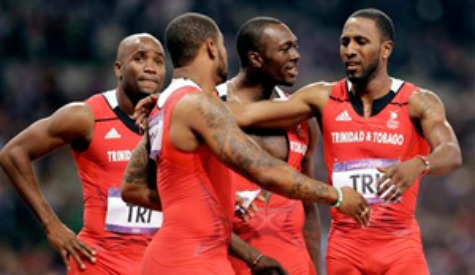
 The men's javelin gold won by Keshorn Walcott at the Olympic Games, here in London, England, combined with the three bronze medals secured on the track, earned Trinidad and Tobago joint 47th spot on the medal table, with Uzbekistan.
The four-medal haul was the largest for T&T in Olympic history. The country's success, however, cannot be measured only in precious metal.
There were 12 top-eight finishes for T&T at London 2012.
Walcott led the way with his golden shocker. Lalonde Gordon's men's 400 metres bronze was also a surprise.
Keston Bledman, Marc Burns, Emmanuel Callender and Richard "Torpedo" Thompson combined for bronze in the men's 4x100m. And there was bronze as well for Gordon, Jarrin Solomon, Ade Alleyne-Forte and Deon Lendore in the 4x400m.
Cyclist Njisane Phillip just missed out on a trip to the podium, finishing fourth in the men's sprint. He also competed in the keirin, copping seventh spot.
Kelly-Ann Baptiste was sixth in the women's 100m final—the best ever Olympic placing for a female athlete from T&T. Jehue Gordon got to the men's 400m hurdles final, the 20-year-old athlete finishing sixth in the championship race. And Thompson was seventh fastest in the men's 100m dash.
In the pool, George Bovell touched the wall seventh in the men's 50m freestyle final. Yesterday, the 29-year-old swimmer capped off his fourth Olympic Games campaign by carrying the T&T flag at the closing ceremony, at the Olympic Stadium.
Semoy Hackett finished eighth in the women's 200m. And in the women's 4x100m, Michelle-Lee Ahye, Baptiste, Kai Selvon and Hackett progressed from the qualifying round, but were non-finishers in the final, a baton bungle halting their medal bid.
Chef de mission Annette Knott said that the strong showing here in London was the dawn of a new era in T&T sport.
"We have stepped up to another level. What we need to do now is take it to the next level, where we can turn these placings into medals."
Knott told the Express there was uneasiness in the T&T camp during the London Games.
"When we started, we speculated where we would get the medals. There was always hope in the relays, and we were also looking towards George and Njisane.
"But we were getting only finalists," she continued, "and not medals. While there was still confidence in the camp, there was some anxiety, especially with the comments on Twitter and Facebook."
Things changed last Monday, after the men's one-lap final.
"Once Lalonde medalled, there was more hope that anything can happen."
Knott said the T&T Olympic team was a unified bunch.
"There were no cliques. The pre-Games camp (in Wales) really made a difference with team unity. We were one big family."
The chef de mission said that while Jamaica emerged as the top English-speaking nation at the Games--finishing 18th on the medal table with four gold medals, four silver and four bronze—T&T's all-round performance is worthy of commendation.
"We sometimes sell ourselves short. We have people in many events, and there has been a steady progression. We have finalists not only on the track, but we're doing well in cycling and swimming as well. All-round, I'd say we're ahead of the Caribbean.
"I'm very proud to manage this team," Knott ended. "There's a great feel good factor."
By Kwame Laurence
Source: www.trinidadexpress.com
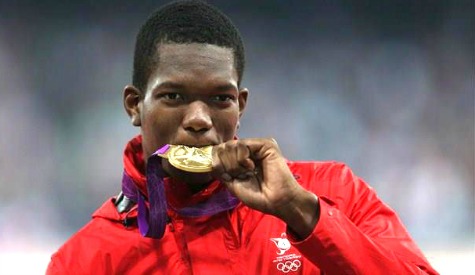 Keshorn Walcott’s gold medal may have been the biggest surprise of the Olympic Games in London, England. Yesterday, Walcott shocked everyone at Olympic Stadium when his second throw of 84.58 metres topped the Men’s Javelin event, less than a month after he became the world junior champion. He astonished himself also, saying, “I’m surprised I even made the final. I just went out there to relax and enjoy it and it worked out. “It means everything to me. This is what it’s all about.” Walcott, from Toco, pushed T&T’s medal count to three before the men’s 4x100m relay team of Richard Thompson, Keston Bledman, Emmanuel Callender and Marc Burns added a bronze medal to make it four—T&T’s best medal haul at an Olympic Games.
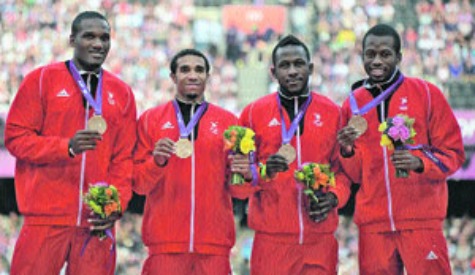 Sport Minister Anil Roberts described yesterday as the country's "most successful day in our Olympic history".
 Keshorn Walcott produced a shocker at the Olympic Stadium here in London, England, yesterday, becoming only the second Olympic gold medallist from Trinidad and Tobago.
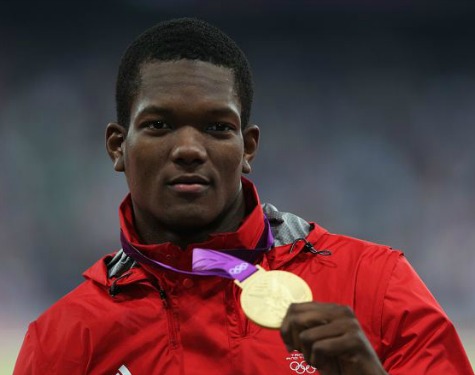 Trinidad's Keshorn Walcott completed a remarkable double by taking a surprise Olympic javelin gold less than a month after becoming world junior champion.
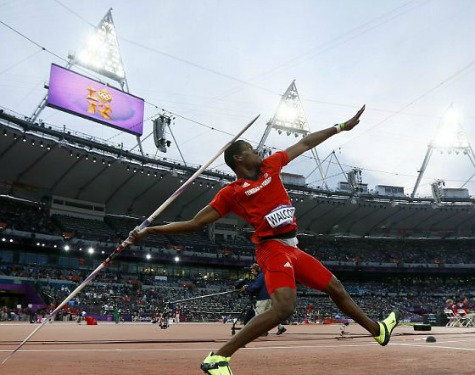 There had looked to be plenty of potential winners in the field, including defending Olympic champion Andreas Thorkildsen from Norway and the Czech Republic's Vitezslav Vesely, who threw 88.34 metres in the qualifying rounds and is coached by three-time Olympic champion Jan Zelezny.
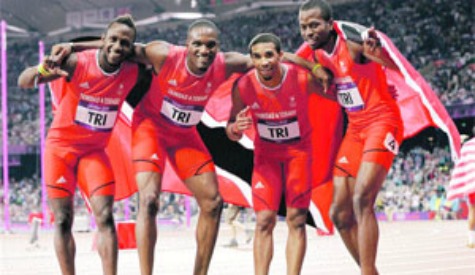 Deon Lendore ran his heart out for Trinidad and Tobago at the Olympic Stadium, here in London, England, yesterday, battling to the line to earn his team bronze in the London 2012 men's 4x400 metres relay.